
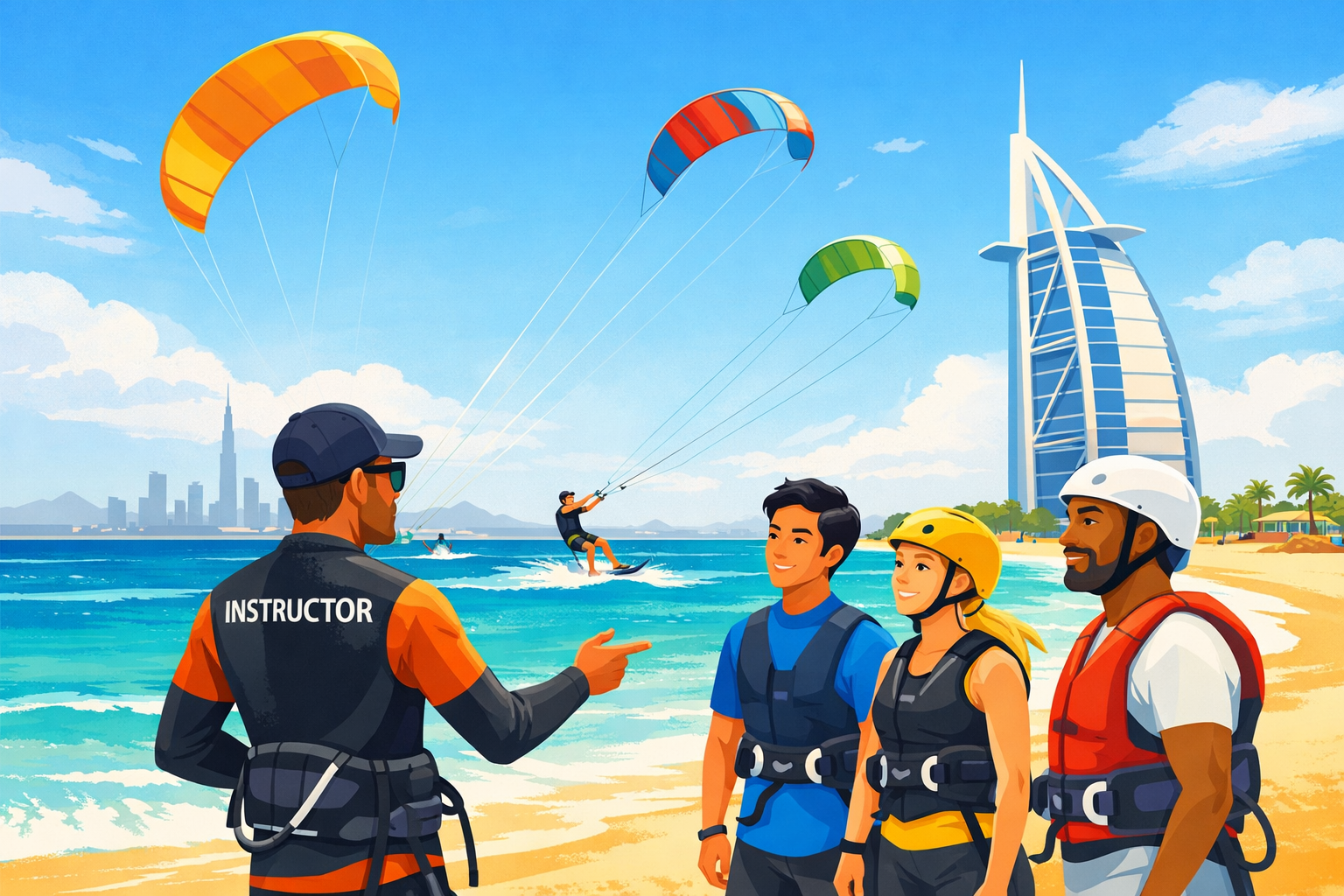
Bringing a kitesurfing instructor to Dubai's Kite Beach in 2026? The visa rules, attestation chain, and timing matter more than your IKO certification. Here's the real playbook.
When the Shamal Wind Returns to Kite Beach
Every October, something shifts along the 14-kilometre stretch of coastline between Sunset Beach and Umm Suqeim 3. The dominant wind angle changes, the humidity drops, and suddenly the water off Kite Beach turns into one of the most reliable kitesurfing playgrounds in the Northern Hemisphere. By the time November lands, the schools are fully booked, the IKO-certified instructors are running back-to-back lessons, and Dubai Sports Council is processing event permits for everything from freestyle competitions to long-distance downwinders heading toward Jebel Ali.
And that's exactly when the visa headaches start.
Because here's the thing most people don't realise: bringing a qualified kitesurfing instructor into the UAE isn't a tourist visa exercise. It involves sport coaching credentials, attested teaching certificates, sometimes a freelance permit, sometimes an employment contract — and if the paperwork isn't lined up correctly by September, you'll be watching the season's best wind days from the beach instead of teaching on them. I've spent the last decade reporting on Gulf tourism and sports industries, and the 2026 season is shaping up to be the busiest Kite Beach has seen since the spot was officially gazetted as a watersports zone. Demand is up. Schools are expanding. And the visa rules — particularly around attested coaching qualifications — have quietly tightened.
Let me walk you through what actually matters.
Why Dubai's Kitesurfing Season Has Become a Global Magnet
Dubai's wind season runs roughly from October through April, with peak conditions between December and March. The shamal — that northwesterly wind that sweeps down the Arabian Gulf — delivers consistent 12 to 25 knot days, warm water hovering around 22°C in January, and the kind of postcard backdrop (Burj Al Arab on one side, Palm Jumeirah on the other) that turns Instagram into a recruitment tool for kite schools.
What this means in practice: instructors from Tarifa, Cape Town, Brazil, Mauritius, Phuket and Hood River all converge on the UAE for a season's work. Some come for three months. Others get hired by established schools and stay for years. A handful arrive as freelancers, hop between Kite Beach, Nessnass Beach and the lagoons at Al Marmoom, and build a clientele entirely on word-of-mouth.
But the UAE labour market doesn't care how good your kite control is. It cares whether your IKO Level 2 or VDWS instructor certificate has been properly attested in the country it was issued, then legalised at the UAE Embassy, then stamped by MOFA in Dubai. That's a three-step chain that, depending on the issuing country, can take anywhere from 10 days to six weeks. Plan badly, and your season is gone.
In my conversations with the operations managers at three of Kite Beach's licensed schools, the same complaint kept surfacing: instructors arrive with paperwork that looks fine in Cape Town or Cabarete, but doesn't survive the MOFA process here. The fix isn't complicated — but it requires somebody who actually understands how the Ministry of Foreign Affairs and the UAE attestation system work in 2026.
The Three Visa Routes — And Which One Actually Fits You
There isn't a single "kitesurfing instructor visa." There are three legitimate pathways, and choosing wrong is the most expensive mistake you can make. Honestly, I've seen instructors waste AED 8,000 and four weeks because somebody told them "just come on a tourist visa, we'll sort it out." Don't.
Route One: Employment Visa Through a Licensed Watersports Operator
This is the cleanest option if you've already been hired by a DET-licensed school operating on Kite Beach. The employer sponsors your work permit, your residency visa gets issued under their establishment card, and your trade-tested profession is typically registered as "Sports Coach" or "Sports Instructor." Salary thresholds, Emirates ID, medical fitness test, biometrics — the standard MOL process applies.
The catch? Your IKO, VDWS or BKSA certification has to be attested in the country of origin. A Brazilian instructor with an IKO certificate issued in Brazil needs Brazilian attestation, Brazilian Ministry of Foreign Affairs legalisation, then UAE Embassy Brasília stamp, then MOFA Dubai. A South African instructor — different chain entirely.
Route Two: Freelance Permit Under a UAE Free Zone
For independent instructors who want to teach across multiple beaches, multiple schools, or run their own private clients, the freelance permit route has become genuinely viable since 2023. Several free zones — including those in Dubai Media City and the Creative Cluster — issue freelance permits that cover sports coaching as a profession. You get a permit, a three-year residency visa, and the legal right to invoice schools and clients directly.
But — and this is the part most blogs gloss over — to register "Sports Coach" as your freelance activity, you typically need attested professional certifications submitted at the application stage. No attestation, no permit. And because freelance permits aren't tied to an employer, you carry the entire administrative burden yourself. That's where a serious visa agency and attestation services partner like Green Apple Travel & Tourism actually earns its fee — they know which free zones currently accept which sport coaching qualifications and which ones quietly stopped processing them in late 2025.
Route Three: Short-Term Mission or Visit Visa (For Competitions and Clinics)
If you're coming for a 10-day clinic, a competition, or a brand-sponsored event — say, you're a pro rider invited to coach at a Kite Beach event — a properly structured visit visa works. Some events qualify for sports-specific entry visas issued via the host federation, but these require sponsorship from a UAE-licensed sports body. The validity is short, the rules around "paid coaching activity" are strict, and overstaying or earning income outside the declared scope is the fastest way to get blacklisted from future UAE entries.
Most full-season instructors should ignore Route Three entirely. It exists for guest coaches, not seasonal workers.
The Attestation Chain Nobody Explains Properly
Here's where I see the most expensive mistakes — and I want to spell it out because the official websites are genuinely confusing.
UAE attestation works on a country-of-issue principle. The document has to be legalised in the country where it was originally issued, then verified by the UAE Embassy in that country, then re-stamped by the UAE Ministry of Foreign Affairs once you arrive. There are no shortcuts. There are no "online attestations" that bypass this chain. And, critically, an IKO certificate isn't automatically treated as an "educational document" by every UAE authority — sometimes it's classified as a professional certificate, which routes it through a slightly different attestation channel.
For a kitesurfing instructor, the typical document set requiring attestation includes:
- The kitesurfing instructor certification itself (IKO, VDWS, BKSA, FFVL, IKSA — whichever body issued it)
- First Aid and CPR certifications, particularly if the school requires them under their insurance policy
- Educational degree, if you're applying for a freelance permit that requires a minimum education level
- Police clearance certificate from your country of citizenship and any country you've resided in for the past five years
- Marriage certificate, if you're bringing a spouse on family sponsorship
Each of these documents goes through the same three-step chain. Each costs money. Each takes time. And if you arrive in Dubai without them attested at source, you'll spend weeks trying to courier originals back home, which is both expensive and risky — I've heard one too many stories of documents lost in transit between Dubai and Recife.
The smarter approach is to handle the source-country attestation before you fly, then complete the MOFA Dubai stamp once you land. This is the model that the attestation services team at Green Apple Travel & Tourism has refined since 2012 — they coordinate with embassies in over 50 countries, which matters when you're trying to get a VDWS certificate attested in Germany while you're already running clinics in Dubai.
Timing the Process Against the 2026 Season
Let me get specific about the calendar, because this is where good planning beats good intentions.
The Dubai kite season effectively starts in mid-October. Schools begin running full schedules by the first weekend of November. Peak instructor demand runs from December 1 through the end of March. If you want to be teaching by November, here's the realistic backward-planning timeline:
June–July 2026: Begin source-country attestation of your instructor certifications and educational documents. In most European countries this takes 2–4 weeks. In Brazil, South Africa, and several Asian countries, expect 4–8 weeks.
August 2026: Submit your employment contract or freelance permit application. If you're going the employment route, your sponsoring school applies for your entry permit. Processing is typically 5–10 working days, but August in the UAE means longer queues — many government employees are on summer leave through mid-September.
September 2026: Enter the UAE on your entry permit, complete medical fitness testing, Emirates ID biometrics, and final residency stamping. If you've already pre-attested your professional documents, MOFA Dubai attestation can usually be completed within 3–5 working days.
October 2026: Final school onboarding, IKO membership verification, watersports operator briefings.
Leave any of these stages until the last minute and you're either teaching illegally or missing the season. There is no third option.
For those needing urgent visa solutions — say, a school just had an instructor pull out three weeks before the season, and they need to bring someone in fast — there are express processing channels that can compress this timeline to roughly 10–14 days, but they're expensive, paperwork-intensive, and only realistic if your attestations are already complete in your home country.
What the Schools Actually Look For Beyond the Paperwork
I want to add something most visa guides don't bother with, because it affects whether you actually get hired in the first place — and therefore whether the visa even matters.
Kite Beach operators are picky. Insurance requirements have escalated significantly since 2022, and most established schools now require instructors to hold:
- IKO Level 2 minimum (Level 3 strongly preferred), or equivalent VDWS/BKSA certification
- Current First Aid and CPR certification, ideally within the past 12 months
- Powerboat licence or equivalent (because rescue boat work is part of nearly every senior instructor's job at Kite Beach)
- Demonstrable teaching hours, often with reference checks to previous schools
- Reasonable English communication, since the client base ranges from European tourists to GCC residents to expat families across 40+ nationalities
Many schools also prefer instructors who can speak a second or third language — Russian, French, German and Arabic are all in high demand because they match the dominant tourist segments arriving in Dubai during the kite season.
If you're missing any of these, sort them out before you apply for the visa. The visa process assumes you already have the qualifications. It doesn't create them for you.
Common Mistakes I've Watched Instructors Make
A few patterns repeat themselves every year, and they're worth flagging.
First — assuming that a tourist visa converts easily into a work permit. It can be done in some cases via in-country status change, but it's not the default, and the cost of getting it wrong is a fine plus an exit-and-re-entry process that eats into your earning days.
Second — using uncertified translation. If your instructor certificate is in Portuguese or German or French, you'll need certified Arabic or English translation for some attestation steps. Cheap online translation services don't survive MOFA scrutiny. Use a legal translator approved by the UAE Ministry of Justice, or work with a documentation specialist who already has those translator relationships.
Third — ignoring police clearance certificate requirements. PCC documents have validity windows. A certificate issued more than six months before your visa application is usually rejected. Get the timing right, or you'll redo it.
Fourth — misjudging the freelance permit costs. The permit itself is reasonable, but combined with residency visa, Emirates ID, mandatory health insurance, attestations and translation, the total first-year cost typically lands between AED 14,000 and AED 22,000 depending on the free zone and visa duration. Budget accordingly.
Fifth — and this one's avoidable — not engaging a serious visa applications specialist early enough. Global visa appointments at busy embassies (especially during European summer) book out weeks in advance. If you're a Brazilian instructor needing UAE Embassy Brasília attestation in August, you'd better have started in June.
Frequently Asked Questions
Conclusion: Get the Paperwork Out of the Way, Then Go Ride
Here's the honest truth about coming to Dubai to teach kitesurfing in 2026: the wind, the water, the clients, the money — all of it works. The reputation Kite Beach has built over the past decade is genuine. What trips people up isn't the riding. It's the bureaucracy that surrounds the riding. And bureaucracy, fortunately, is solvable — provided you start early and work with people who know the system.
If you're an instructor planning the 2026 season, or a school owner trying to bring in a roster of qualified coaches, the smartest move you can make right now is to map your attestation chain against your arrival timeline. Get the certifications attested at source. Get your contracts and permits in order before you fly. And use a documentation partner who actually knows the difference between a sports coach permit issued by IFZA and one issued through Dubai Media City.
The team at Green Apple Travel & Tourism, operating from offices on Khalid Bin Al Waleed Road and Sheikh Zayed Road since 2012, handles exactly this kind of multi-jurisdictional documentation work — visa applications, MOFA and embassy attestations, certified translations, police clearance assistance, and the urgent visa solutions that seasonal industries like watersports tend to need. With over 1,477 verified Google reviews and DTCM licensing, they're one of the few visa agencies in Dubai with both the embassy relationships across 50+ countries and the attestation specialists in-house — which is exactly what the kite season demands.
To start your 2026 season properly, message their team on WhatsApp at +971 4 370 5995, or schedule a callback through their website. Tell them you're coming in as a kitesurfing instructor — they'll know exactly which chain to start first.
The shamal won't wait. Neither should you.
Tags
Share this article
About This Article
This article was written and published as part of Green Apple Travel & Tourism's blog subscription with HanzWeb. Our AI Blog Platform researches industry keywords, drafts long-form SEO content in the client's brand voice, and publishes after client review and approval. Every article is unique to the subscribing business. Learn about the service →