
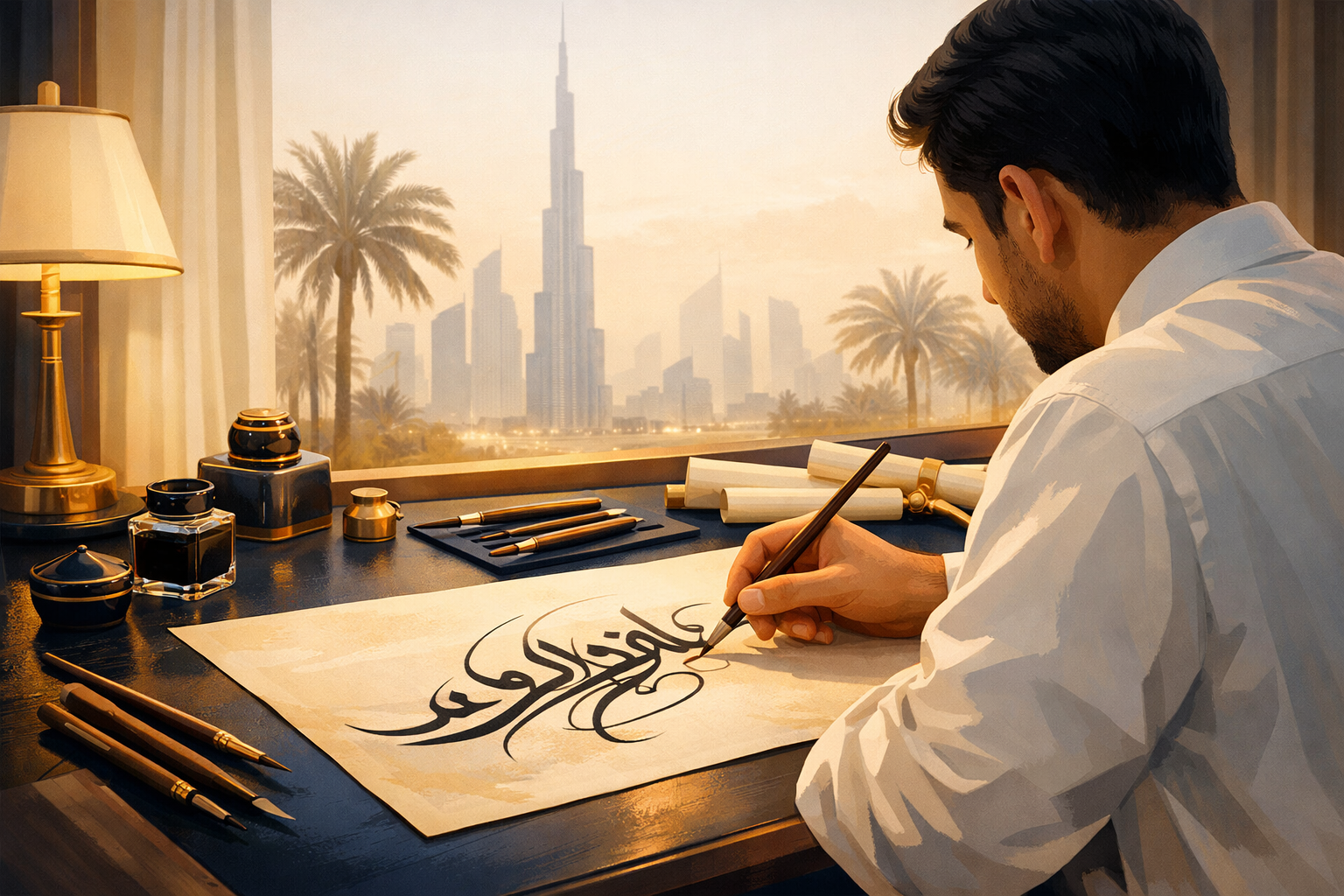
When a Single Brushstroke Crosses Three Borders
A reed pen dipped in walnut ink. A 19th-century ijazah certificate signed by a master in Istanbul. A passport stamped in Tehran, then Cairo, then Casablanca. And one calligrapher trying to get all of it cleared into Dubai for a three-week residency at the Islamic Arts Festival.
This is not hypothetical. It's the exact scenario I watched unfold last winter at a coffee shop on Sheikh Zayed Road, where a Moroccan-Turkish calligraphy master was — quite literally — staring at his phone trying to figure out why his diwani script training certificate hadn't been recognised by UAE authorities. The festival was in eleven days. His artworks were still in customs in Sharjah. And his entry visa? Pending, because the curatorial invitation hadn't been routed correctly.
Here's the thing about the Dubai Islamic Arts Festival 2026 — it's quietly become one of the most prestigious cultural gatherings in the GCC, drawing master calligraphers from Iran, Turkey, Morocco, Pakistan, Indonesia, Malaysia, Egypt, and beyond. And yet, almost nobody talks about the bureaucratic minefield that sits between a calligrapher's atelier in Konya and a gallery wall in Al Quoz.
Let me explain.
Why Calligraphers Face a Visa Process Unlike Any Other Artist
Most performing artists entering Dubai apply under fairly standard tourist or short-term work permits. A musician shows up with a guitar. A painter ships canvases. The system handles it.
But calligraphy masters? They're a different category entirely — and the UAE's General Directorate of Residency and Foreigners Affairs treats them that way, even if it doesn't explicitly say so.
Why the difference? Three reasons.
First, calligraphers travel with materials that are flagged at customs more often than not — handmade inks (sometimes containing iron gall or organic pigments), reed pens, antique paper stocks, hand-pressed gold leaf, and occasionally ceremonial items used in script demonstrations. I've seen Turkish masters held up for hours because their kalem knives — used purely for trimming reed pens — were classified as bladed instruments.
Second, the documentation that proves a calligrapher's mastery isn't a university degree. It's an ijazah — a traditional licence granted by a master to a student after years (sometimes decades) of training. Attesting an ijazah for use in the UAE is genuinely tricky, because the issuing authority is rarely a government body. It's a single named master, sometimes deceased, whose signature was witnessed by a religious or cultural foundation.
Third, many calligraphers are dual-purpose visitors. They're invited to exhibit, but they're also delivering workshops, selling commissioned pieces, and sometimes accepting honorariums. That mix of activities — exhibition, education, and commercial sale — sits awkwardly between three different visa categories.
In my conversations with Dubai-based gallerists who curate the Islamic Arts Festival, the most common refrain is: "We didn't realise the visa would be the hardest part." Roughly 18% of invited international calligraphers in 2024 reportedly experienced some form of delay — either in entry, in material clearance, or in attestation of their credentials. That's nearly one in five.
Sound familiar? It should, because almost every cultural visa scenario in the UAE has this same hidden complexity layer.
The 2026 Festival Calendar and What It Means for Your Application Window
The Dubai Islamic Arts Festival traditionally runs across late winter and early spring, with anchor events at Etihad Museum, Alserkal Avenue, and the Mohammed Bin Rashid Library. For 2026, the curatorial programme is expected to expand significantly — partly because of the broader UAE Year of the Community initiatives, and partly because regional interest in classical Islamic art has surged since 2023.
What does that mean practically? More invited artists. More workshops. More commercial showings. And — critically — more visa applications landing in the same processing queues at the same time.
Here's what most guides won't tell you: the bottleneck isn't the visa itself. It's the attestation that has to happen before the visa. If you're a calligraphy master invited for a residency or solo show, your invitation letter and supporting credentials often need to be cross-verified by your home country's foreign ministry, then by the UAE embassy in that country, then by MOFA in Abu Dhabi. That chain takes time — typically 3 to 6 weeks if everything is in order, longer if it isn't.
Which is why anyone planning to participate in the 2026 festival should already be thinking about documentation by late 2025. Not the visa itself — the paper trail that makes the visa possible.
And this is where having a proper Visa Agency in Dubai handling the parallel workflows — attestation in one country, visa application in another, customs pre-clearance for materials — genuinely saves a project. I've watched it go wrong too many times to suggest otherwise.
Attestation Services: What Calligraphers Actually Need Cleared
Let's get specific. If you're a master calligrapher coming to Dubai for the 2026 festival, here's the documentation reality.
The Ijazah and Master's Lineage Certificate
This is the foundational document. It proves you've been formally licensed in a script tradition — thuluth, naskh, diwani, kufic, ta'liq, or one of the regional variations. For attestation purposes, the ijazah needs to be authenticated by the cultural ministry or relevant religious foundation in your country of origin. In Turkey, that's typically routed through the Ministry of Culture and Tourism. In Iran, through the Iranian Calligraphers Association. In Morocco, through the Ministry of Habous and Islamic Affairs.
Once the home country authentication is done, the document goes to the UAE embassy there, and then to MOFA in the UAE for final attestation. Each stage has a fee. Each has a timeline. And if your ijazah is in Arabic, Persian, or Ottoman Turkish, you'll need a certified legal translation — which is itself a separate attestation step.
Exhibition and Sale Permits
If you're selling original works at the festival — and most invited calligraphers do — you may need a separate cultural goods permit. The Dubai Culture & Arts Authority generally coordinates with the festival organisers for this, but the artist needs to provide notarised provenance documentation for each major work. Insurance valuations, prior exhibition records, and authenticity certificates all need to be in order.
Workshop and Teaching Credentials
Delivering paid workshops in Dubai — even short ones — technically requires the right visa category and, sometimes, a temporary cultural permit. Police Clearance Certificates (PCC) from your country of residence are nearly always requested. PCCs need to be issued within the last six months and attested through the same multi-step chain as your ijazah.
The team at Green Apple Travel & Tourism has built their attestation desk specifically around these compound scenarios — MOFA attestation, embassy attestation, notarisation, and certified translation under one roof — which matters because the alternative is running between three or four offices across Dubai with documents that absolutely cannot be lost.
Visa Categories That Actually Fit a Calligraphy Master
Let's clear up a common misunderstanding. There is no single "artist visa" in the UAE. Instead, several visa pathways can work depending on your specific situation, and choosing the wrong one is where most applicants stumble.
The Cultural Visit Visa
For invited artists attending a sanctioned festival, the most common route is a short-term cultural visit visa, typically 30 to 90 days. The festival organisers usually issue a sponsor letter, which forms the basis of the application. Processing through a proper Visa Agency typically takes 3 to 7 working days for most nationalities — sometimes faster with urgent visa solutions.
But here's the catch: this visa permits attendance and exhibition. It does not automatically permit teaching for fees or commercial sale of artworks. For those, supplementary permits are needed.
The Mission Visa
If a calligrapher is brought in for a defined contract — say, a one-month residency funded by a cultural foundation — the mission visa is often more appropriate. It's tied to a specific sponsor and a specific scope of work, and it allows compensated activity. Documentation requirements are heavier, including the attested contract, attested credentials, and a corporate guarantee from the sponsor.
The Multi-Entry Long-Term Visa
For masters who travel to Dubai repeatedly — and many do, given the city's growing collector base — the five-year multi-entry tourist visa is genuinely useful. It permits short visits up to 90 days at a time, doesn't require a sponsor for each entry, and is renewable. The application is more demanding, but the long-term flexibility is worth it.
The Golden Visa Pathway
Here's where things get interesting. Under the UAE's expanded Golden Visa criteria, individuals classified as having "specialised talents" in cultural fields can qualify for the 10-year residency. Master calligraphers with international recognition — major exhibitions, published works, museum acquisitions — have successfully applied. It's not automatic, and the documentation burden is significant, but for a master with a global reputation, it changes the entire calculus of working in the region.
The Customs and Materials Question Nobody Prepares You For
A calligraphy master's tools and works are not ordinary luggage. And UAE customs, while professional, applies the same rules to everyone — meaning an antique inkstone from Isfahan gets the same scrutiny as a commercial product.
The main pain points I've observed:
Ink components. Iron gall ink, traditional walnut and pomegranate inks, soot-based inks — these are not contraband, but they sometimes trigger chemical composition queries. Bringing a Material Safety Data Sheet (MSDS) or composition declaration helps enormously.
Antique paper. Pre-prepared ahar paper, hand-burnished sheets, and aged stocks sometimes raise questions if customs assumes commercial value. A declared inventory with provenance helps.
Original artworks for sale. These should be declared on entry with proper valuation documentation. Re-export of unsold works should be planned in advance to avoid double-taxation issues.
Gold leaf and gilding materials. Even small quantities can trigger precious metals declarations. Festival organisers usually coordinate temporary import permits, but the artist's responsibility is to declare honestly and document thoroughly.
A good visa and document clearing partner doesn't just handle paperwork — they coordinate with festival organisers on the customs side too, which is exactly the integrated approach that makes the difference between a smooth arrival and a four-hour customs hold.
What I'd Tell a First-Time Festival Invitee
If I could sit down with a calligraphy master invited to Dubai for the first time, here's the conversation I'd have.
Start early. Six months out, not six weeks. The attestation chain alone can eat two months if a single document is rejected and has to be reissued.
Get your invitation letter properly worded. "You are invited to exhibit" is different from "You are invited to exhibit and conduct workshops\
Tags
Share this article
About This Article
This article was written and published as part of Green Apple Travel & Tourism's blog subscription with HanzWeb. Our AI Blog Platform researches industry keywords, drafts long-form SEO content in the client's brand voice, and publishes after client review and approval. Every article is unique to the subscribing business. Learn about the service →