When a Bartender's Toolkit Becomes a Visa Problem
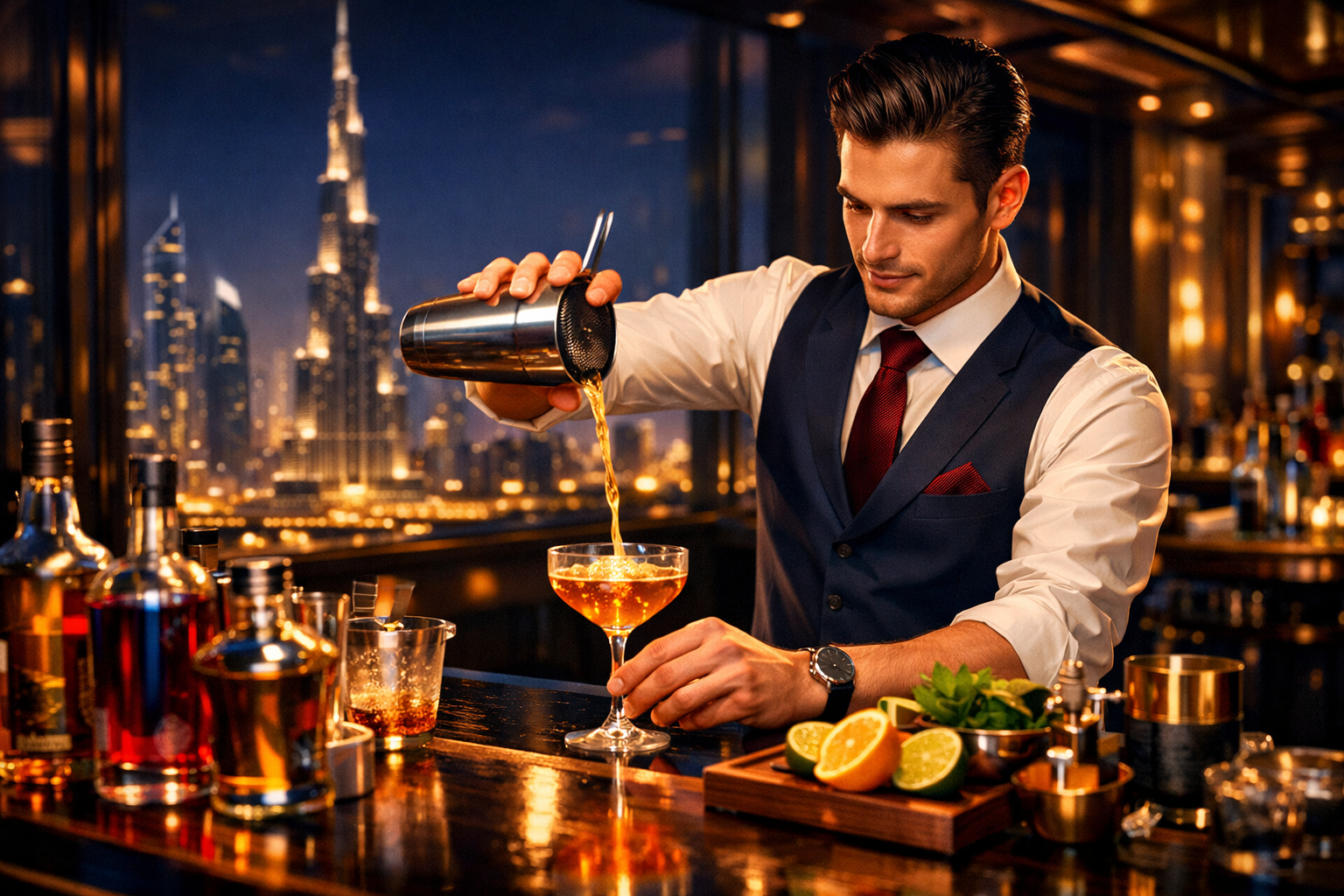
Picture this: a competition-grade bartender lands at DXB carrying a custom Japanese Yarai mixing glass, three hand-forged Hoffman strainers, a torch, and a sealed bottle of homemade shrub he's been tweaking for eight months. He's flown in for the Diageo World Class Bartender of the Year regional finals — one of the most prestigious mixology events on the planet — and he's certain his Schengen visa, his trophy from London, and his sponsor letter from a global spirits brand will be enough.
At secondary inspection, none of that matters.
What matters is whether his entry visa class permits prize-money earnings in the UAE. Whether his recipe books and educational materials have been notarized. Whether the alcohol samples in his case are declared under the right HS code. And whether his "professional bartender" designation lines up with how UAE immigration classifies hospitality professionals entering for competitions.
Here's the thing — the Dubai bar scene has exploded. According to Euromonitor data, the UAE on-trade spirits market crossed USD 1.3 billion in 2024, with Dubai accounting for the majority share. The city now hosts regional rounds for World Class, Bacardi Legacy, Patrón Perfect, and the Tales of the Cocktail global circuit. And in 2026, the Dubai World Class Bartender Finals are expected to draw competitors from over 40 countries.
But every year, a handful of competitors miss their slot — not because they couldn't shake a Daiquiri to perfection, but because their paperwork didn't survive the immigration desk.
This guide is for them. And for the sponsors, brand ambassadors, and bar program managers trying to get them through.
Why Mixology Competitions Are a Special Case for UAE Immigration
Most tourists visiting Dubai never think twice about their visa category. They get a 30-day visit visa, drink at Zero Gravity, post a few photos, and fly home. Simple.
A competing mixologist's situation is fundamentally different — and this is where most travel guides get it wrong.
When you enter the UAE to compete in a brand-sponsored event with prize money, sponsorship payouts, or product demonstrations on behalf of a commercial entity, you're technically engaged in professional activity. The standard tourist visa doesn't cover that. And in 2026, with the UAE's enhanced biometric border systems and AI-assisted document checks at DXB and DWC, the days of "just say you're a tourist" are over.
There are essentially three legitimate routes:
The Mission Visa (also called the Temporary Work Permit, MOHRE-issued): This is a 90-day permit issued through the Ministry of Human Resources and Emiratisation. It's specifically designed for short-term professional engagements — exactly the category competitive bartenders fall into when they're being paid or sponsored by a UAE-licensed entity. The host venue or the brand's UAE distributor typically applies on the bartender's behalf.
The Sponsored Visit Visa via the host hotel or brand: Diageo, Pernod Ricard, Bacardi, and Beam Suntory all operate through UAE-licensed distributors who can sponsor competitor visas. If you're traveling under brand sponsorship, this is usually the cleanest route. Processing runs 3 to 5 working days through a competent agency.
The Standard 30 or 60-Day Tourist Visa with declared purpose: Acceptable only when no prize money is involved and you're competing in your personal capacity — for example, a regional qualifier where you've self-funded entry. You still need to declare the competition at immigration if asked, and you'll need supporting documentation.
In my conversations with hospitality professionals over the past three years, the single most common mistake I see is bartenders entering on a tourist visa, then accepting a USD 5,000 sponsor payout in cash or wire. That triggers tax residency questions, work permit violations, and — in some cases — a five-year re-entry ban.
Don't do that. The visa categories exist for a reason, and a properly-issued Mission Visa costs less than the entry fee for most major competitions.
Attestation: The Document Trail Most Bartenders Don't Know They Need
Let me explain something that surprises almost everyone in this industry.
When you're entering Dubai as a credentialed professional — and a World Class competitor with media coverage, brand contracts, and prize obligations counts — UAE authorities may request attested copies of your qualifications. This is especially true if you're staying beyond 30 days, applying for a Mission Visa, or transitioning into a longer engagement (think: brand ambassador residency, masterclass series, pop-up bar takeover).
The documents that typically need attestation:
Educational certificates — bartending school diplomas (think European Bartender School, BarSmarts Advanced, Wine & Spirit Education Trust Level 3 in Spirits, or Court of Master Sommeliers credentials if you're crossing into wine territory). These must be attested from the issuing country, then by the UAE Embassy in that country, then by the UAE Ministry of Foreign Affairs in Dubai.
Professional references and employment letters from previous bars — particularly if you're claiming a track record at a globally-ranked venue (anything in the World's 50 Best Bars list, for instance). Letters need notarization in the country of origin, embassy attestation, and MOFA attestation.
Police clearance certificates (PCC) — required if you're applying for any work-linked visa class, including the Mission Visa for longer durations. The PCC must be issued within the last six months and fully attested.
Recipe book and intellectual property documentation — this one's niche but increasingly important. If you're competing with a proprietary cocktail and want to protect the recipe or commercialize it through a Dubai bar partnership post-competition, attested authorship documents make life dramatically easier.
The attestation chain is unforgiving. Miss one stamp, and the whole document gets bounced. Which is exactly why working with the document clearing team at Green Apple Travel & Tourism saves competitors days of back-and-forth between consulates and ministries — they handle the MOFA, embassy, and notary layers as a single workflow, including expedited processing when a competition deadline is closing in.
Honestly, this is one of the most overlooked aspects of professional travel into the UAE. Bartenders prepare obsessively for their flights of cocktails. They rarely prepare for the paper trail.
The Customs Question: Tools, Spirits, and Ingredients
There's a separate problem most competitors don't anticipate until they're standing at the customs red channel: your kit.
A serious competitor's flight case can contain items that look very different to a customs officer than they do to a bartender. Crystal glassware. Sharp barware (paring knives, channel knives, peelers). Cooking torches. Sealed bottles of housemade ingredients — shrubs, syrups, bitters, tinctures, the occasional clarified milk punch. And in some cases, sample bottles of finished spirits used for tasting calibration.
UAE customs is sophisticated and generally reasonable, but you have to play by the rules.
Alcohol samples — even sealed competition entries — must be declared. Each adult passenger is permitted up to 4 liters of alcohol or 24 cans of beer for personal use, but commercial samples for events fall under a separate category and typically require pre-approval through the event organizer's licensed alcohol distributor. If you're competing under Diageo's World Class umbrella, the local distributor (MMI or African + Eastern, generally) handles the bonded import of competition spirits. Your job is to not show up with undeclared bottles in your carry-on.
Homemade ingredients are trickier. A bottle of fermented pineapple tepache or a clarified Bloody Mary base will look suspicious to scanners. Bring an ingredient list in English and Arabic, declare them on entry, and where possible, work with the event organizer to ship perishables ahead of time under their event import permit.
Tools — knives, torches, atomizers, smoking guns — should go in checked luggage with a printed inventory. I've seen competitors lose 90 minutes at baggage reclaim because a bartender's torch tripped an explosives flag. A simple typed manifest defuses that within minutes.
A quick reality check: the Dubai market is one of the most welcoming environments in the world for serious mixology — Galaxy Bar, Bar 1971, Mimi Kakushi, and Society Café all routinely rank in regional Top 50 lists. The city wants you here. The customs process just expects you to be prepared.
Timing the Application: A Realistic 2026 Calendar
Here's where strategy meets bureaucracy.
The Dubai World Class Finals 2026 are part of a broader competition calendar that includes regional heats, brand-sponsored masterclasses, and the global final. If you're a competitor, your travel window is rarely just "a few days." Most serious competitors are in Dubai for 7 to 14 days — for rehearsal, calibration, media commitments, and post-competition appearances.
A realistic timeline looks like this:
12 weeks before competition: Begin document attestation in your home country. This is the single longest lead-time item. Embassy attestation of educational certificates alone can take 4 to 6 weeks in markets like the UK, India, the Philippines, and Brazil — all major source countries for elite bartending talent.
8 weeks before: Confirm sponsor sponsorship letters and event invitations. Your sponsoring entity (brand, distributor, or host hotel) needs to issue a formal invitation letter on company letterhead, signed by an authorized signatory whose details match the UAE trade license.
6 weeks before: Initiate the Mission Visa or sponsored visit visa application. The Mission Visa goes through MOHRE and typically clears in 5 to 10 working days. The sponsored visit visa clears faster — 3 to 5 working days through GDRFA — but requires the sponsor to have an active UAE establishment card.
3 weeks before: Complete customs pre-clearance for any equipment and samples you're shipping ahead. Air freight from London or Singapore typically takes 5 to 7 days through DXB cargo, with customs clearance adding another 2 to 3 days for specialty items.
1 week before: Final document verification. Visa printed and emailed. Travel insurance arranged with mention of competition activity (standard tourist insurance often excludes "professional sporting/competitive events," and yes, bartending competitions sometimes get classified that way by underwriters).
Now, what about the bartender who calls a visa agency on Tuesday and flies on Friday? It happens — qualifier rounds get expanded, alternates get called up, sponsors make last-minute decisions. For genuinely urgent visa solutions, expedited Mission Visa applications can sometimes clear in 48 to 72 hours when a UAE-licensed sponsor is already in place. Not always. But often enough that it's worth knowing the door exists.
What Sponsors and Bar Programs Should Be Doing
If you're a bar program manager, brand ambassador team lead, or competition organizer reading this — most of the friction in this process is on your side, not the competitor's.
The brands that get this right (Pernod Ricard's Absolut team in the UAE has been particularly sharp on this) treat visa logistics as part of the competitor onboarding package. They:
- Pre-qualify the visa class based on prize structure before the competitor even books flights.
- Maintain a relationship with a Dubai-based visa and document clearing agency that can handle global visa appointments across the source markets their competitors come from.
- Build a document checklist into the competitor acceptance email, with country-specific attestation requirements clearly flagged.
- Pre-arrange the alcohol sample import under their distributor's event permit.
- Provide a single point of contact for customs questions on arrival day.
When this is done right, competitors arrive focused and rested. When it isn't, they spend their first 36 hours in Dubai panicking about paperwork instead of dialing in their service flow.
For smaller sponsors and independent bars hosting takeovers around the main competition — the unofficial economy that surrounds every major bar event — this matters even more. The big brands have legal teams. You probably don't. Outsourcing the visa and attestation workflow to a specialist visa agency is almost always cheaper than getting one of your guest bartenders denied entry.
Frequently Asked Questions
Can I compete in the Dubai World Class Finals on a standard tourist visa?
In limited circumstances, yes — but it depends entirely on the prize structure and your sponsor arrangement. If you're competing at a regional qualifier with no monetary prize and no UAE-based brand sponsor paying you to be there, a standard 30 or 60-day visit visa is technically sufficient. However, the moment you accept prize money, appearance fees, sponsor payouts, or in-kind compensation from a UAE-licensed entity, you've crossed into professional activity territory, which legally requires a Mission Visa or sponsored work-linked entry. The penalty for getting this wrong includes fines, deportation, and re-entry bans of up to five years. Our strong recommendation: if there's any commercial dimension to your competition presence — and at finals level there almost always is — apply for the Mission Visa. It's affordable, processed quickly, and protects you and your sponsors.
How long does the attestation process actually take for a bartender from India or the Philippines?
Realistically, plan for 3 to 6 weeks end-to-end, though it can be compressed with expedited services. For an Indian bartender, the chain runs: notary attestation in India → State Home Department attestation → Ministry of External Affairs (MEA) attestation → UAE Embassy attestation in New Delhi → MOFA attestation in the UAE. Each layer adds days. For Filipino bartenders, the process runs through DFA attestation in Manila and UAE Embassy attestation there, followed by MOFA Dubai. The fastest legitimate timeline we've seen is 8 working days for fully expedited service across both legs. The slowest — when documents have errors and bounce back — can stretch past two months. Starting early is genuinely the only way to control this. Once a document enters the chain, you're at the mercy of consular timelines.
What happens if customs holds my competition spirits or homemade ingredients at DXB?
If items are held, you have a few options depending on what was flagged. For declared, legitimately permitted competition spirits, the resolution is usually a call from your UAE distributor or event organizer providing their bonded import paperwork — items are typically released within 4 to 24 hours. For undeclared alcohol exceeding personal allowance, items will be confiscated and you may face a fine, though competition entries are usually treated more leniently than concealed quantities. For homemade ingredients flagged as unidentified liquids, you can sometimes have them tested and released, but the process takes 24 to 72 hours and the items may not be usable in time for your service. The reliable workaround: have your sponsor ship perishable ingredients ahead under their event permit, and bring only sealed, labeled, declarable items in your personal luggage.
Can I bring my partner or family on a Mission Visa for the competition period?
The Mission Visa itself is single-applicant — it doesn't include dependents. However, your spouse and children can apply for separate standard tourist visas covering the same dates, which is a routine application processed in 3 to 5 working days. If your visit extends past 90 days and you transition into a longer-term residency category (some competition winners get offered brand ambassador contracts that include UAE residency), you'd then be able to sponsor dependents under that new visa class. For competition week itself, the cleanest setup is your Mission Visa plus standard tourist visas for accompanying family, all applied for in parallel. A good visa agency processes these as a single coordinated package.
Do I need separate insurance for competition activities, and does the UAE require it?
Yes — and this catches a lot of competitors off guard. The UAE requires valid health insurance for visa issuance, which most standard tourist insurance policies satisfy.
Tags
Share this article
About This Article
This article was written and published as part of Green Apple Travel & Tourism's blog subscription with HanzWeb. Our AI Blog Platform researches industry keywords, drafts long-form SEO content in the client's brand voice, and publishes after client review and approval. Every article is unique to the subscribing business. Learn about the service →