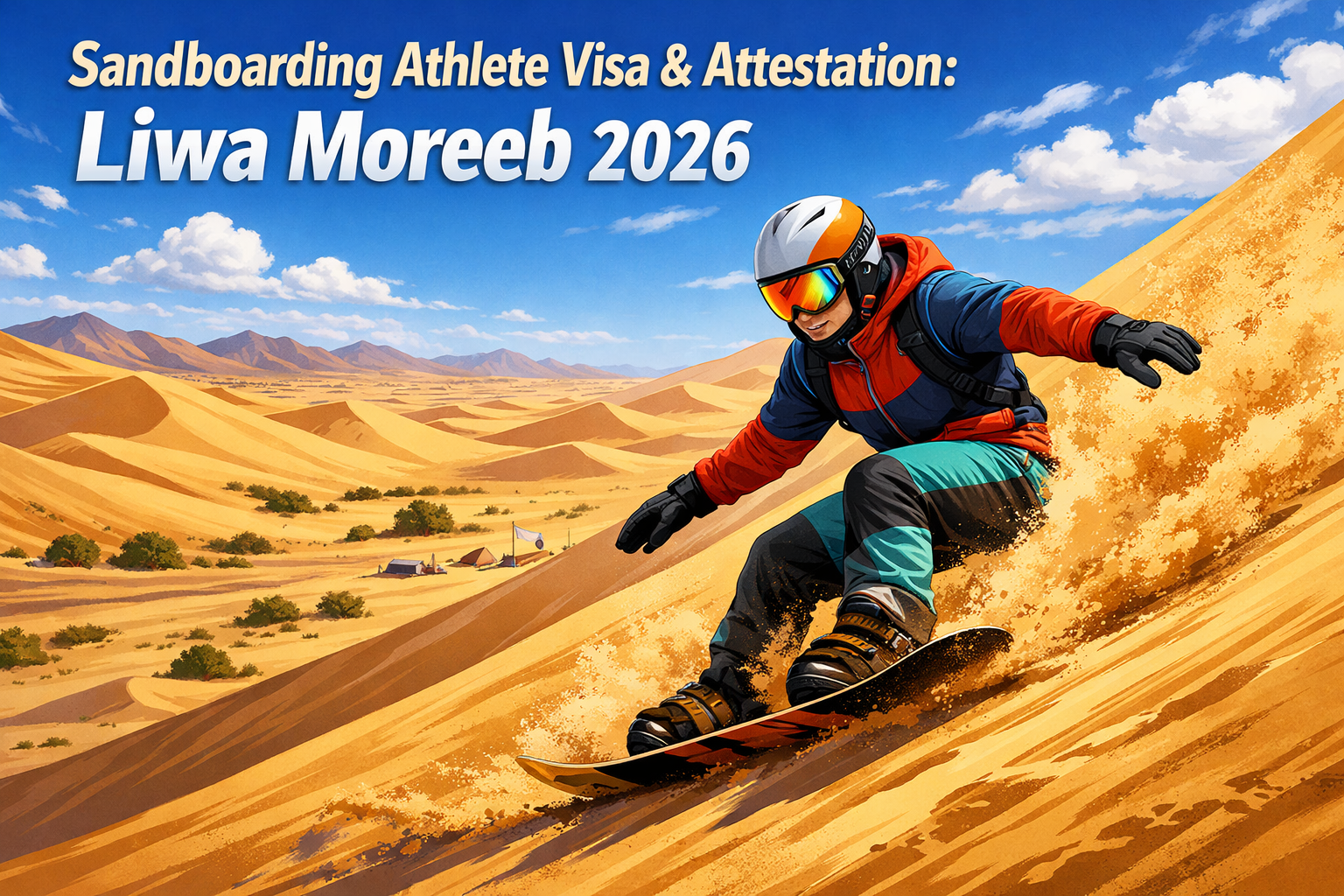

A working guide to Indian visa categories, MOFA and embassy attestation, and Dubai transit logistics for heli-ski guides and operators running Kashmir charter operations in the 2026 season.
When the Helicopter Lifts Off in Gulmarg, Your Paperwork Should Have Landed Three Months Ago
The Pir Panjal range gets serious snow. Not the manicured, groomed-twice-daily variety you find in Verbier or Niseko — we're talking deep, untracked, often unstable Himalayan powder that drops above 4,000 metres and demands a guide who knows where the wind has loaded a slope and where it hasn't. That's the business of heli-skiing in Kashmir. And it's quietly becoming one of the most interesting backcountry charter products being routed out of Dubai for the 2026 season.
But here's what most operators won't say out loud: the skiing is the easy part. Getting a certified heli-ski guide — Austrian, Canadian, Swiss, Kiwi, whoever holds the IFMGA pin — legally cleared to work a Kashmir charter season, with the right Indian visa category, with attested credentials that Srinagar's licensing authorities actually recognise, while transiting through or basing out of the UAE? That's where charters fall apart. And that's where guides lose a season.
This guide is for the operators, lodge managers, and independent guides building a Dubai-to-Kashmir charter pipeline for January through March 2026. The visa side. The attestation side. The transit logistics. And the things almost nobody tells you until something gets stamped "refused."
Why Dubai Has Become the Staging Ground for Kashmir Heli-Ski Charters
For a niche corner of adventure travel, this is a surprisingly Dubai-centric story.
The reason is geography plus aviation infrastructure plus client base. Kashmir's heli-ski season is short — roughly mid-January to mid-March, with the best snow window often falling in February. Clients flying in from Europe, North America, Australia and the GCC tend to consolidate in Dubai for two practical reasons: direct connectivity into Srinagar (SXR) via multiple Indian carriers, and the ability to pre-position gear, finalise insurance, and meet guides before pushing into a region where backup support is thin.
Dubai also works for guides. A certified mountain guide flying from Innsbruck or Whistler often needs 24–48 hours to clear time zones, finalise Indian visa stamping if required, and collect attested paperwork before continuing to Srinagar. The UAE's hub status, plus its document-clearing infrastructure — MOFA, embassy attestation desks, notary services — make it a logical pit stop rather than a detour.
And this is where a Dubai-based visa and attestation partner like Green Apple Travel & Tourism becomes more than a convenience. For charter operators running multi-guide rotations across an eight-week season, having a single point of contact in Dubai handling visas, MOFA stamps, embassy legalisation and last-minute amendments is the difference between a smooth season and a series of expensive ground delays.
The Indian Visa Question: Which Category Does a Heli-Ski Guide Actually Need?
This is the part where most independent guides get it wrong — and the consequences range from being turned around at SXR immigration to getting a working visa cancelled mid-season.
A heli-ski guide is not a tourist. Even if the operator pays the guide outside India, the work itself — leading paying clients on commercial descents, briefing on snow safety, signing off on rescue protocols — is professional activity conducted on Indian soil. The Indian government takes a fairly strict view of this distinction. Showing up on an e-Tourist visa and guiding paying clients is, technically, a visa violation.
The Indian visa categories that typically come into play for heli-ski guides include:
- Employment Visa (E-Visa, not to be confused with e-Tourist) — required where the guide has a formal contract with an India-registered operator and is being paid through India. Requires a salary threshold and supporting documents from the employing entity.
- Business Visa (B-Visa) — used where the guide is engaged as an external consultant or contractor for a short engagement, typically representing a foreign company or being paid offshore for services rendered to an Indian client. Eligibility is narrower than most people assume.
- Mountaineering Visa (MX) — managed via the Indian Mountaineering Foundation for expeditions. This is generally for peak attempts, not commercial heli-ski operations, but worth understanding because the categories sometimes overlap in border regions.
Which category applies depends on the contract structure, the operator's Indian registration, payment flow, and duration. There is no one-size-fits-all answer, and getting this wrong is the single most common failure point. Anyone serious about a Kashmir charter season should confirm the correct category directly with the Indian Embassy in Abu Dhabi or the Consulate General in Dubai, or work with a licensed visa specialist who handles Indian sub-classes regularly.
Kashmir-Specific Considerations
Kashmir adds a layer most other Indian destinations don't have. Foreign nationals are generally permitted to visit Srinagar and Gulmarg as tourists, but commercial activity — particularly involving aerial operations — falls under additional scrutiny. Operators running heli-ski charters typically coordinate with local authorities and the DGCA on the aviation side, and that paper trail benefits enormously from guides whose visa category cleanly matches what they're actually doing on the mountain.
Attestation: The Step Nobody Wants to Do, Until They Have To
A heli-ski guide's value lives in their credentials. IFMGA certification. CAA Level 3 avalanche qualifications. Wilderness first responder. Helicopter long-line training. Operator-specific endorsements. These documents are evidence that the person standing at the LZ briefing clients actually knows what they're doing.
For a UAE-routed charter season, those documents often need to be attested before they're recognised by Indian authorities or by the lodge's insurance underwriters. The attestation chain depends on the document's country of origin, but the general flow looks like this:
- Notarisation in the country of issue (e.g. a Swiss notary for IFMGA paperwork issued in Switzerland).
- Apostille or foreign ministry authentication in that country.
- Embassy attestation — either the UAE Embassy in the issuing country, or the Indian Embassy, depending on where the document needs to be presented.
- MOFA attestation in the UAE if the document will be used or recognised through a UAE entity.
- Indian Embassy attestation in the UAE if the document is to be presented to Indian authorities and the guide is transiting through Dubai.
For guides arriving from countries that are part of the Hague Apostille Convention, the process is faster — an apostille often replaces several embassy steps. The UAE joined the Apostille Convention in 2025, which has streamlined parts of the chain for documents originating in or destined for member states.
This is genuinely complex paperwork. And it's the kind of work where a Dubai-based attestation services team that runs MOFA, apostille and embassy chains daily saves operators weeks of stress. Building it into the charter timeline — not leaving it to a last-minute scramble — is what separates professional seasons from chaotic ones.
Insurance Document Attestation
An often-overlooked piece: heli-ski operations require very specific liability and personal accident insurance, and the underwriting paperwork sometimes needs to be cross-attested for use across jurisdictions. If a UK-based guide is covered by a UK policy, but operating commercially in India through a Dubai-routed charter, the insurance documentation may need to be authenticated to be enforceable. Worth checking with the broker months ahead.
Building the Charter Timeline: A Realistic Backwards Plan
The Kashmir heli-ski window is brutally short. February is the heart of the season. That means everything — visas, attestation, guide rotation, client visas, equipment shipping — has to converge in early-to-mid January.
Here's a sensible backwards plan for a guide or operator targeting a February start:
October–early November 2025: Confirm guide roster. Begin collecting certifications, contracts, and personal documents from each guide. Identify which visa category each guide needs based on contract structure.
Mid-November: Initiate notarisation and apostille processes in each guide's home country. This stage is the slowest because it involves third parties you don't control.
Early December: Begin UAE-side attestation work. MOFA stamps, embassy attestation, any required translations. This is also the window for visa applications — Indian Employment and Business visas can take several weeks depending on workload at the relevant mission and any required additional clearances.
Late December–early January: Final visa stamping, transit booking through Dubai, gear pre-positioning. Confirm that each guide's attested document set will arrive in Srinagar before they do — or travels with them as a sealed packet.
Mid-January: Guides land in Dubai for 24–48 hours, collect any last documentation, brief on charter logistics, push to Srinagar.
The single most common reason guides miss the opening week of a charter season isn't snow or flights. It's a stuck attestation step or a visa category that had to be re-filed. Build a 10-day buffer into every guide's plan. Always.
Client-Side Visas: The Charter's Other Half
Most of the focus above has been on the guides. But a heli-ski charter doesn't exist without clients, and their visa pathway runs in parallel.
The good news: most heli-ski clients can use India's e-Tourist visa, which is straightforward for the majority of nationalities, including many European, North American, GCC and Australian passport holders. The application is online, the documentation light, and processing typically completes within a few business days for standard cases.
The complications come from specific nationalities — Pakistani passport holders face a separate process, certain African and Middle Eastern passports require additional scrutiny, and clients with previous Indian refusals need careful handling. For charter operators marketing to a global client base out of Dubai, having a partner that runs urgent visa solutions across multiple nationalities — including handling rejected-applicant resubmissions and consolidated group visa appointments — keeps the business commercially viable.
This is also where global visa appointments matter: a charter operator selling to a Saudi family group of six, plus three independent skiers from Germany, plus a UK couple, plus a heli-ski cinematographer from Canada — that's six different document sets running on different timelines. A coordinated visa agency in Dubai treats it as one project.
The Dubai Transit: What to Actually Do With Your 48 Hours
For guides routing through Dubai, the 24–48 hour layover is a working window, not a holiday. A few practical notes:
- Gear inspection. Dubai's dry heat and dust are not friends to ski gear stored long-term, but a transit stop is fine. Use the time to inspect probes, beacons, airbag canisters and avalanche cords. Airbag canisters are the perennial flight headache — check airline rules for both the inbound leg and the Dubai-to-Srinagar onward leg, as policies vary.
- Document collection. If MOFA or Indian Embassy stamps are being finalised in Dubai, this is when you collect them. Build the appointment into your transit, not your arrival in Srinagar.
- Client briefings. Some operators use Dubai as the client meet-up point, particularly for groups arriving from multiple continents. Hotel meeting rooms in Deira or DIFC work well for a pre-departure brief on snow conditions, kit checks and emergency protocols.
- Last-mile insurance confirmation. Make sure heli-evacuation and medical evacuation coverage is confirmed in writing before boarding the SXR flight. Once you're in Gulmarg, sorting an insurance gap is painful.
Why the Operator-Visa Partner Relationship Matters Across a Season
A single visa is a transaction. A charter season is a relationship.
Over eight weeks of Kashmir operations, things change. A guide gets sick and a replacement has to be visa'd inside 72 hours. A client cancels and their booking gets transferred to someone whose passport throws a curveball. A documentary crew gets added late and needs business visas with film-permit alignment. An insurance renewal triggers a new attestation requirement.
The operators who run smooth seasons aren't the ones who handle all of this in-house. They're the ones who've built a working relationship with a Dubai visa and document-clearing partner who already knows their charter, their guide roster, and their preferred routing. When the urgent call comes at 9pm on a Tuesday, the work starts immediately because the file is already half-built.
FAQ
Can a heli-ski guide work in Kashmir on an Indian e-Tourist visa?
No — and this is one of the most consequential mistakes in adventure-tourism staffing. The e-Tourist visa explicitly prohibits employment, business activity, or paid professional engagement. Guiding paying clients on commercial heli-ski descents is professional activity regardless of where the guide is paid. Guides caught working on tourist visas risk deportation, visa cancellation, and future entry refusals. The correct category is typically an Employment Visa or Business Visa, depending on contract structure and payment flow. Operators should confirm the specific category with the Indian Embassy in Abu Dhabi or Consulate in Dubai before finalising any guide's travel plan. Working with a visa specialist familiar with Indian sub-classes is strongly recommended for first-season operations.
How long does the full attestation process take for a European-issued IFMGA certificate?
It depends heavily on the country of issue and how many embassy steps are required. For a document originating in an Apostille Convention member state (which includes most European countries), the chain is typically: notarisation, apostille from the issuing country's foreign ministry, then MOFA attestation in the UAE if required. Realistically, you should budget four to six weeks for the full process from start to finish, factoring in delays at any single step. Documents that require additional embassy legalisation — for example, certain Asian or African qualifications — can take longer. The fastest way to compress the timeline is to start as early as possible and use a Dubai-based attestation services partner who can run parallel steps and chase missing stamps in real time.
What's the difference between MOFA attestation and Indian Embassy attestation in the UAE?
MOFA attestation refers to the UAE Ministry of Foreign Affairs stamping a document to confirm that prior attestations (notary, embassy of issuing country) are legitimate. It's a UAE-side validation. Indian Embassy attestation, by contrast, is when the Indian Embassy or Consulate in the UAE specifically attests a document for use in India. Many documents destined for use in India require both — MOFA first, then the Indian mission. The order matters, and skipping a step typically means starting over. For heli-ski guide credentials, insurance documents, and contractual paperwork being presented to Indian authorities or partners, you'll usually need both stamps. A visa agency that runs both desks daily can sequence them correctly the first time.
Do clients booking a Kashmir heli-ski trip from Dubai need any special permit beyond an Indian visa?
For most foreign clients, a standard e-Tourist visa is sufficient for tourism activities in Srinagar and Gulmarg. However, certain backcountry or restricted-area movements may require additional permissions, particularly if the operation moves into areas near sensitive borders. Operators should clarify the exact terrain plan with their Indian operating partner well in advance, as some Inner Line Permits or Protected Area Permits may apply depending on the precise zones being skied. Clients should also carry comprehensive insurance that explicitly covers helicopter operations, off-piste skiing above 4,000 metres, and medical evacuation — generic travel insurance typically excludes all three. Confirm this in writing with the underwriter before departure.
Can Green Apple Travel handle a multi-nationality guide roster in a single charter season?
Yes — this is precisely the kind of consolidated work a Dubai visa agency is built for. A typical Kashmir charter season might involve guides from Austria, Canada, New Zealand and Switzerland, plus clients from twelve different passport nationalities, plus a film crew on separate documentation. Coordinating that volume in-house drains an operator's time. A licensed Dubai visa partner can run all guide visas, all client visas, all attestation chains, and all urgent visa solutions for last-minute roster changes through a single project manager. This is particularly valuable for operators who don't have a dedicated office in the UAE but need a Dubai presence to handle MOFA, embassy work, and global visa appointments across the season.
Closing the Season Before It Starts
A Kashmir heli-ski charter season lives or dies on logistics that have nothing to do with snow. The skiing is what you sell. The paperwork is what makes the selling legal.
For the 2026 season, the operators who'll run smooth eight-week rotations are the ones who started the visa and attestation work in October, built a Dubai-based document partner into their operating plan, and treated their guide credentials with the same seriousness as their avalanche protocols.
If you're an operator, lodge, or independent guide planning Dubai-to-Srinagar charter movements for January through March 2026, start the conversation now. Green Apple Travel & Tourism handles Indian visa categories, MOFA and embassy attestation, urgent visa solutions, and consolidated global visa appointments out of their Khalid Bin Al Waleed Road and Sheikh Zayed Road offices in Dubai — and they've been doing it since 2012. Reach out via WhatsApp or schedule a callback through their site to get a guide roster timeline mapped against the February snow window before the season's first front rolls through the Pir Panjal.
Tags
Share this article
About This Article
This article was written and published as part of Green Apple Travel & Tourism's blog subscription with HanzWeb. Our AI Blog Platform researches industry keywords, drafts long-form SEO content in the client's brand voice, and publishes after client review and approval. Every article is unique to the subscribing business. Learn about the service →